
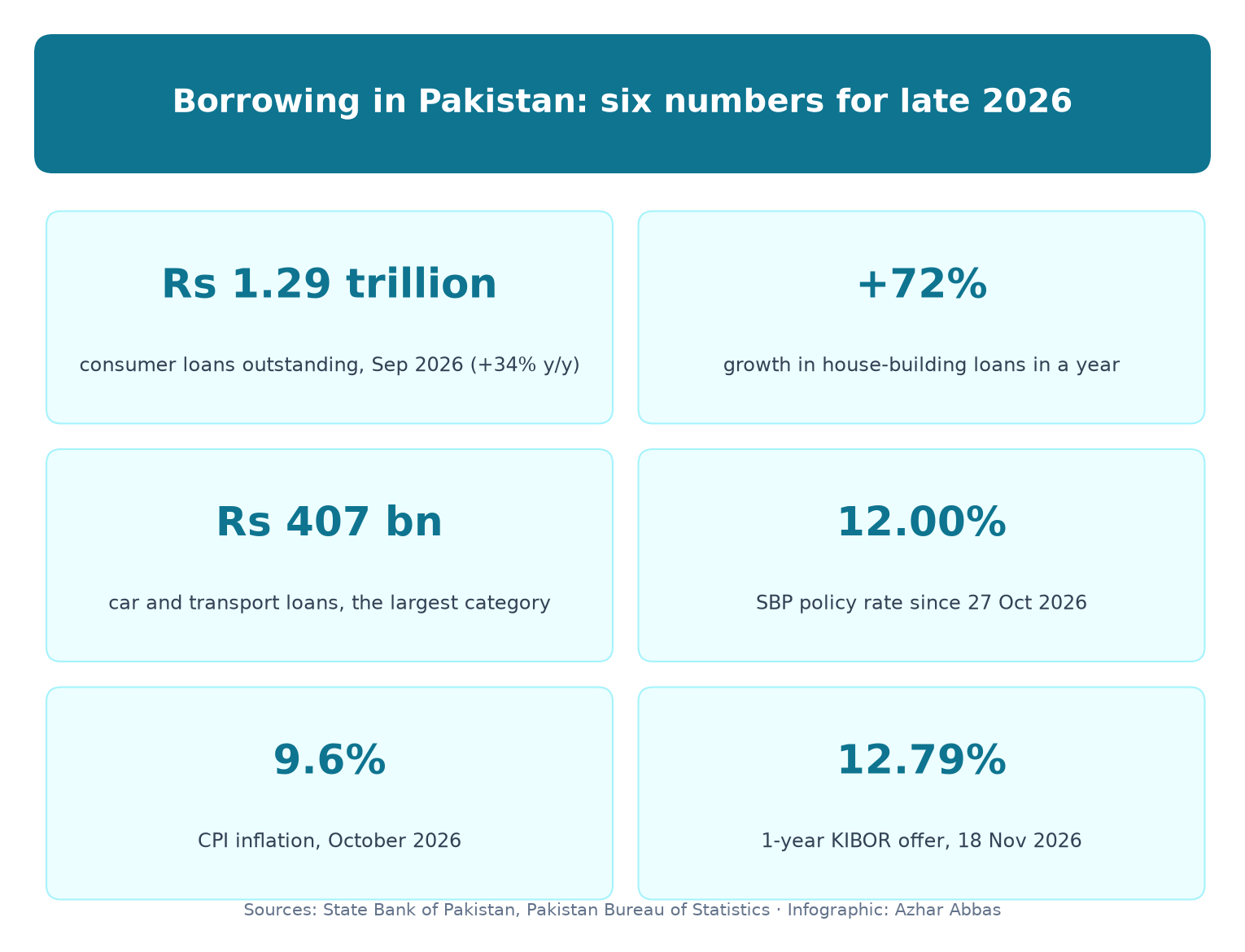
Pakistanis are borrowing again. After two years in which a 22% policy rate froze most consumer lending, bank loans to households grew by about a third in the year to September 2026. Housing finance has grown fastest, car loans remain the biggest category, and all of it is happening while interest rates have started to rise again.
This page pulls the official numbers together, mainly from the State Bank of Pakistan and the Pakistan Bureau of Statistics, and explains what they mean if you are thinking about taking a loan.
How much households owe banks
SBP's data on loans classified by borrower shows consumer financing of about Rs 1,294 billion at the end of September 2026 (provisional), up from Rs 962 billion a year earlier. Loans that banks give their own staff are counted separately and are not included.
| Type of loan | Sep 2025 (Rs bn) | Sep 2026* (Rs bn) | Change | Share of total |
|---|---|---|---|---|
| House building | 212.6 | 365.4 | +72% | 28% |
| Cars & transport | 304.7 | 407.1 | +34% | 31% |
| Personal loans | 263.0 | 300.5 | +14% | 23% |
| Credit cards | 173.0 | 211.5 | +22% | 16% |
| Consumer durables | 8.9 | 9.1 | +2% | 1% |
*Provisional.
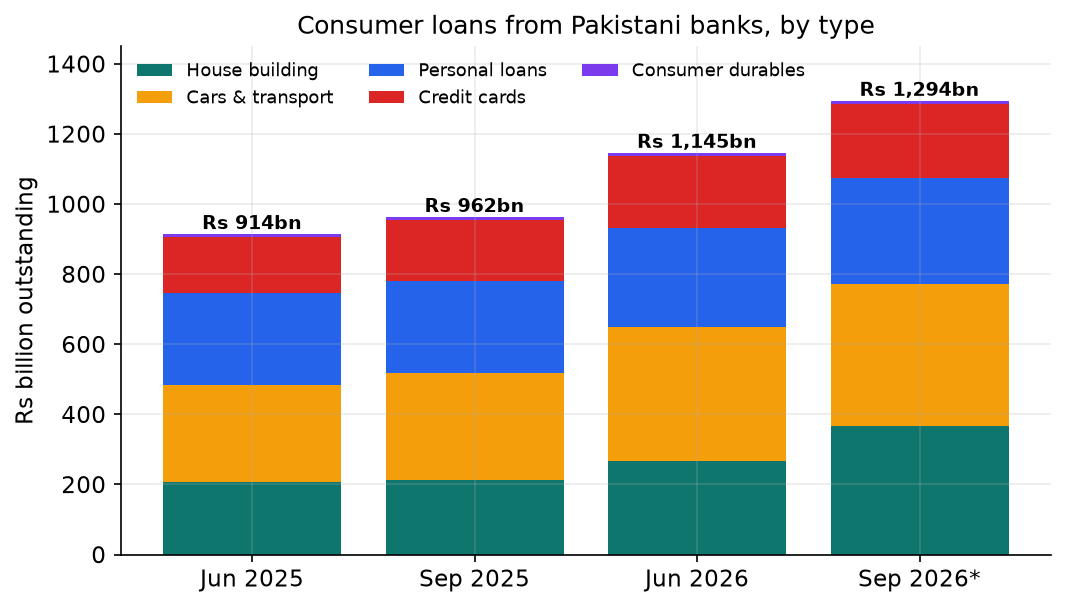
Three things stand out:
- Housing jumped in a single quarter. House-building loans rose from about Rs 267 billion in June 2026 to Rs 365 billion in September. That is the same period in which SBP issued its revised housing finance regulations (18 August 2026), allowing 30-year tenors, 90% financing and a 65% debt burden ratio. The data doesn't prove one caused the other, but the timing is hard to miss.
- Car loans are still the biggest slice, at about 31% of the total, despite SBP's 30% down payment, Rs 30 lakh cap and three-year limit for cars above 1000cc.
- Personal loans grew more slowly, about 14%, and are now smaller than housing loans.
The cost of money: policy rate and KIBOR
The policy rate is the starting point for almost every loan price in the country. It stood at 12.00% on 18 November 2026, after increases of one point in April and half a point in October. The interest rate corridor runs from 11.00% to 13.00%.
KIBOR, the benchmark for most car and home loans, followed: SBP's fixing on 18 November put 6-month KIBOR at 12.46% and 1-year at 12.79% (offer). Ten months earlier, in January 2026, 6-month KIBOR averaged 10.39%.
Real interest rates: the part most people miss
A loan at 15% feels very different when prices are rising 28% a year than when they're rising 6%. The gap between the policy rate and inflation, the "real" rate, is a better guide to how expensive borrowing actually is.
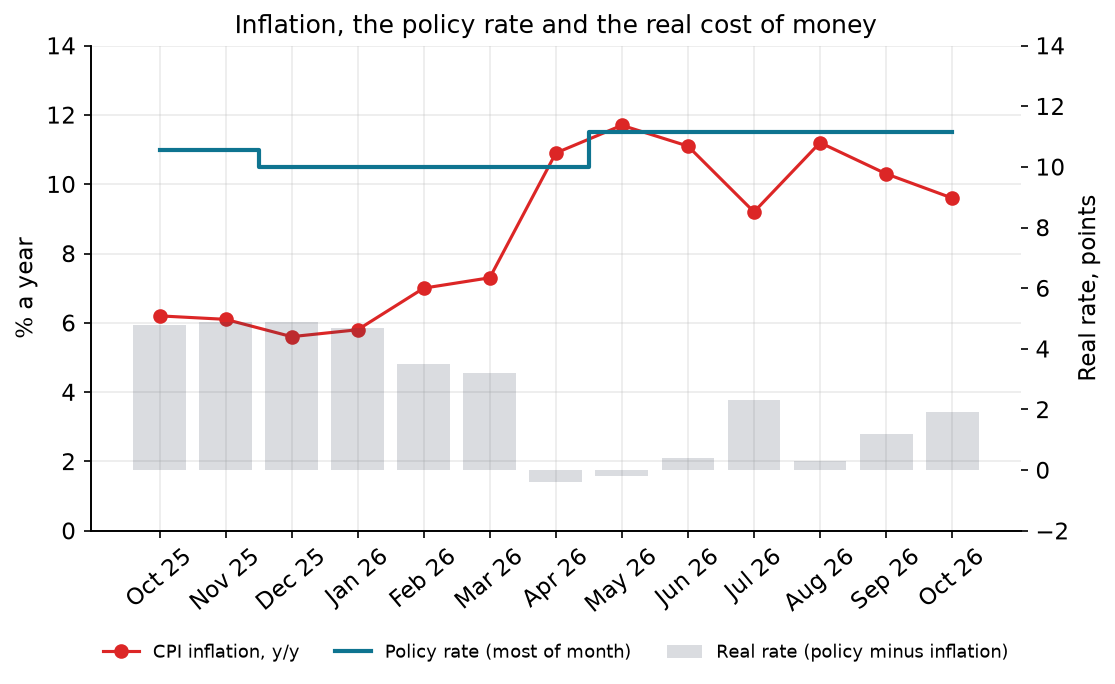
In late 2025 the real rate was close to five points: money was expensive relative to inflation. By mid-2026, as inflation climbed back to 11-12%, the real rate shrank to roughly zero, and briefly below. In October 2026 inflation eased to 9.6% while the policy rate stayed at 11.5% for most of the month, a real rate of about two points.
For borrowers, a low or negative real rate means debt is eroded faster by inflation. For savers it means deposits barely keep their value. Neither situation tends to last long, which is why rates have been moving again.
What banks charge versus what they pay
SBP also publishes the weighted average rate on new loans and new deposits. The gap between the two lines is roughly what banks earn for taking the risk.
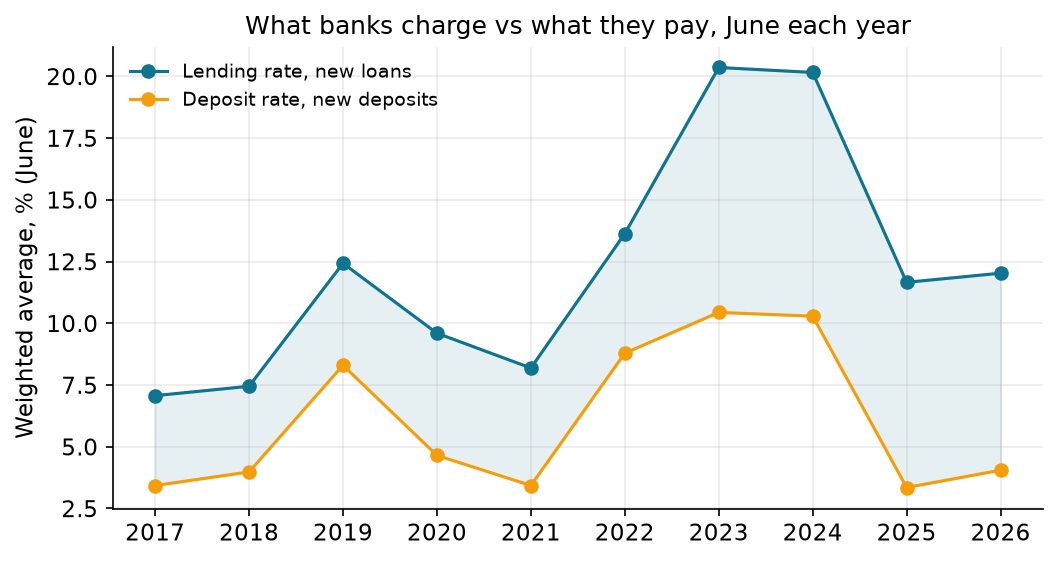
In June 2026 new loans averaged 12.03% and new deposits 4.05%, a gap of almost eight points, wider than in any year before 2023. These are averages dominated by corporate lending; consumer loans are priced well above them. Still, the trend explains why banks are keen to grow consumer lending now.
How we got here: the rate cycle in brief
Today's lending numbers only make sense against the last three years. The key policy rate moves, from SBP's own record:
| Date | Policy rate | What it meant for borrowers |
|---|---|---|
| 27 June 2023 | 22.00% | Record high. With KIBOR above 22%, a KIBOR + 3% car loan cost more than 25% a year. |
| 11 June 2024 | 20.50% | First cut after a year on hold. |
| 17 December 2024 | 13.00% | Five cuts in six months brought rates down by nine points. |
| 6 May 2025 | 11.00% | Borrowing costs back near pre-2022 levels. |
| 16 December 2025 | 10.50% | The low point of the cycle. |
| 28 April 2026 | 11.50% | First increase in almost three years. |
| 27 October 2026 | 12.00% | A further half-point rise. |
Most of the loans now on banks' books were taken between mid-2025 and mid-2026, near the bottom of the cycle. Many are floating-rate, so their installments will rise at the next reset even if the borrower changes nothing.
Credit cards: the quiet growth
Card balances grew about 22% in the year to September 2026, to roughly Rs 211 billion. That is less dramatic than housing, but card debt is the most expensive borrowing most households have. Two points worth knowing: banks usually count about 5% of your total card limit as a monthly obligation when you apply for any other loan, and a card balance that is paid late shows up on your credit report in the same way as a missed loan installment. A large unused limit can therefore reduce how much you can borrow for a car or home.
What this means if you're about to borrow
- Expect competition for housing customers. Rapid growth in a segment usually means banks are willing to negotiate. Ask for a better spread, especially if your salary is paid into the bank.
- Price in rate risk. The policy rate has gone from 10.5% to 12% in under a year. On a floating loan, test your budget at +2 points.
- Look at the real rate, not just the headline. If inflation stays near 10%, a 15-16% loan costs about 5-6% in real terms. If inflation falls fast and rates don't, that real cost rises.
- Keep your credit record clean. With more people applying, banks can afford to be selective. Late payments stay visible on eCIB for two years after settlement.
Where to find the numbers each month
SBP updates the policy rate and KIBOR daily on its website, and the consumer financing data with a lag of a month or two. PBS publishes CPI at the start of each month. If you want the series in one place, the Pakistan loan statistics page on LoanCalculators.pk keeps the policy rate history, KIBOR averages, consumer financing by type and inflation together, with links back to each official table.
Sources
- State Bank of Pakistan, Credit/Loans Classified by Borrowers (consumer financing by type): https://www.sbp.org.pk/ecodata/index2.asp
- Reported summary of SBP September 2026 consumer financing data: https://pakera.pk/check-consumer-loans-september-2026-car-house-credit-card-sbp-pakistan/
- State Bank of Pakistan, policy rate, corridor and KIBOR (18 Nov 2026): https://www.sbp.org.pk/ecodata/rates/msm/MSM-Rates.asp
- SBP, Structure of Interest Rates (weighted average lending and deposit rates): https://www.sbp.org.pk/ecodata/index2.asp
- Pakistan Bureau of Statistics, Monthly Review on Price Indices, October 2026: https://www.pbs.gov.pk/wp-content/uploads/2020/07/Monthly-Review-October2026.pdf
- Dawn, SBP housing finance revision (21 Aug 2026): https://www.dawn.com/news/2024210